
Read Before AI

You may recall that in my personal seasonal system…because I live in Central Texas, where summer is very long and winter is very short, this means I have summer split into two seasons. The early summer is the one where we actually tend to all co-mingle and get together and have summer celebrations. I think of this as show season. The late summer is where it’s just too hot for us to spend much time outside, and that ends up being a much more personal and drowsy time. I still wanted this season, as outgoing and social as it is, to be one where I felt like I was growing and learning, despite it being mostly rounds of submissions and opening receptions.
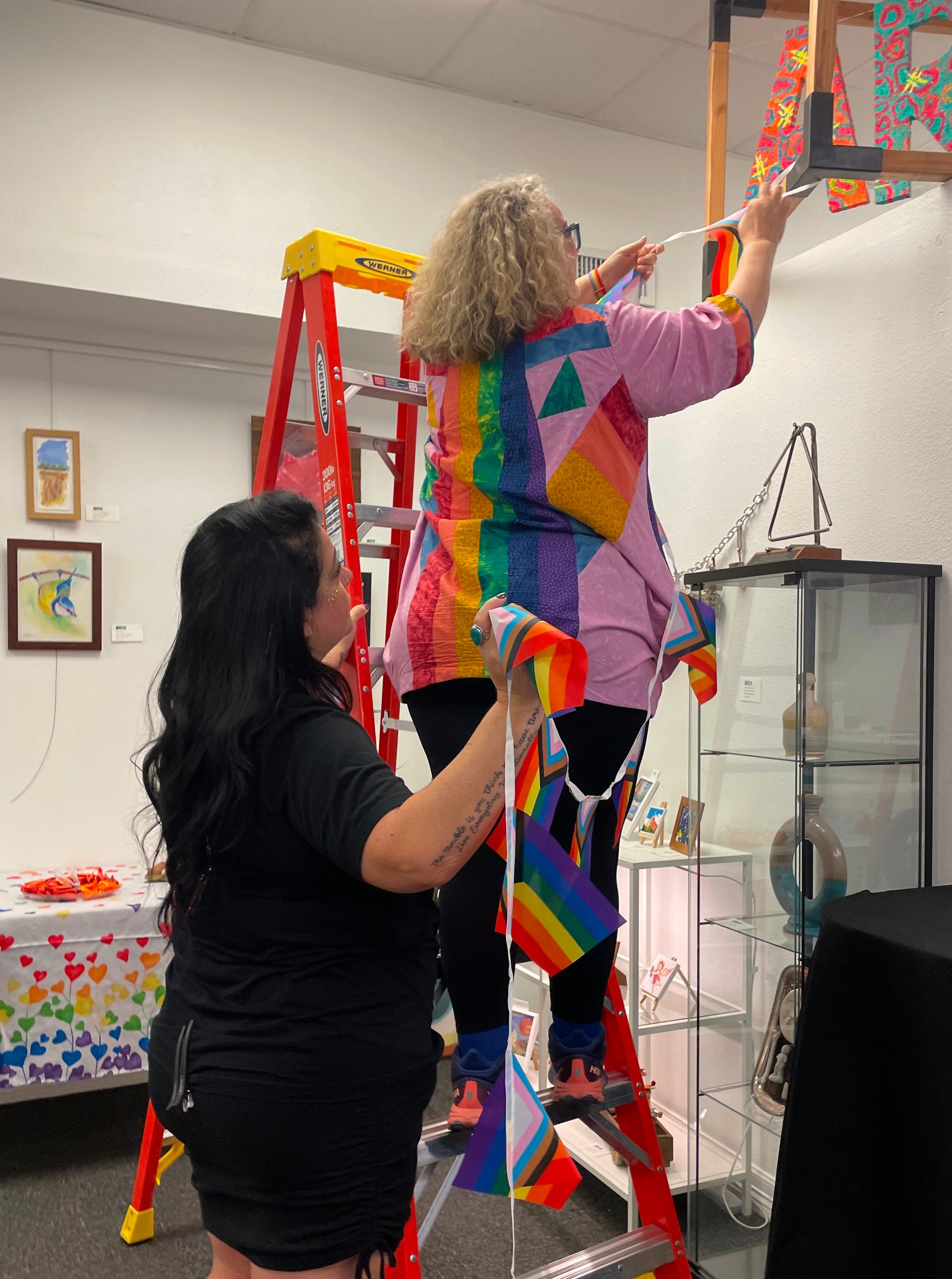
And, you can imagine my surprise when I work up on the day after Memorial Day to discover that, because of a course scheduling error, I was on vacation! My summer teaching, focusing on online entrepreneurship, won’t start until June 30th, and now, instead of being “on”, I need to make the most of my time “off”. This means it is the perfect time to share what I have been learning from my close reading of a book called Icon and Idea by Herbert Read, which I got from AbeBooks. As we entered Early Summer in the middle of April, I made it a season of study by close reading this one book slowly over the course of the eleven weeks the season lasts. Picking this book was a way to add some scholarly thought about art to my life. I also encountered Herbert Read when I was doing some previous work on art education and thinking about how I was teaching my teacher certification students to teach others how to sew.
This book is an example of the genuine scarcity of good art education materials. Quite a lot of what exists is about how to make art, but there’s not nearly as much on how to teach art. Having discovered Herbert Read, I found this book, which is a set of lectures. When I received it, I discovered it was probably going to be an excellent read. The book, which I can take a day or two at a time and practice my handwriting by transferring portions of it into my journal, provides a meditative scholarly activity. In choosing which portions to transcribe, I discovered some of his ideas really struck me, so let me share his central claim.
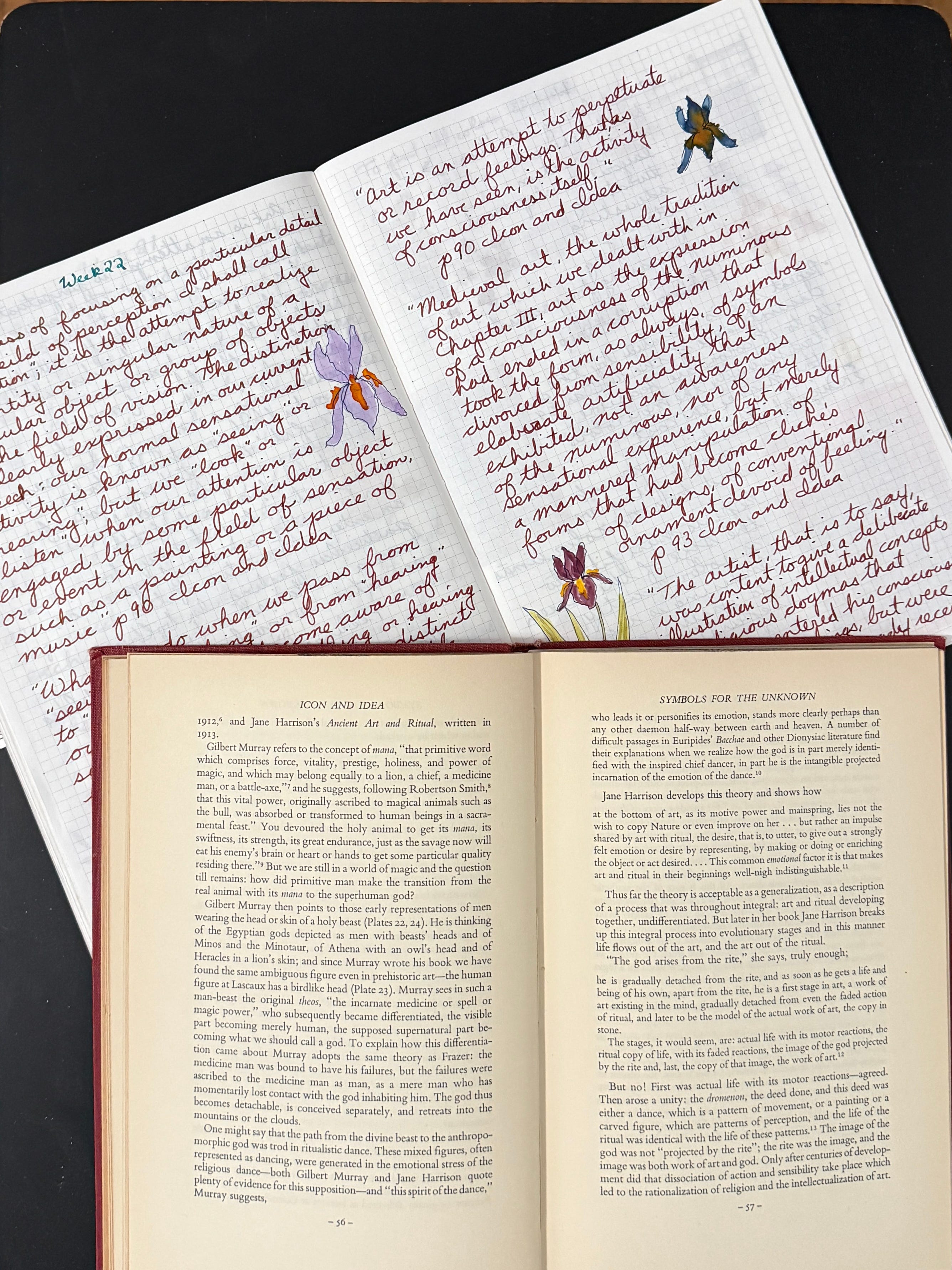
Art came first. Before mythology, religion, and all kinds of other symbolic thought, the capacity to externalize your feelings into something that you can see or touch is not the byproduct of human consciousness, it is actually the driver of it. We don’t have feelings because we’re human. We are human because we have learned how to externalize our feelings. This externalization of sensory input is the engine of human consciousness, not a byproduct. Mythology, science, philosophy, symbolic language, coding, all of this is downstream of the artistic impulse.
“A great part of the modern culture, even the part of it we designate as fine art, is now only distantly related to the process of sensation as such. Just as the process of reasoning can proceed on the basis of signs and symbols which involves no sensational response, so now the process of art proceed on the basis of tropes and images which are not derived from individual experience but are so many counters acquired on the cultural exchange. Schools and academies are established which teach men not to use their senses, not to cultivate their awareness of the visible world but to accept certain canons of expression and from these to construct rhetorical devised whose subtlety appeals to reason rather than sensibility. Art becomes a game, played according to conventional rules. Or it becomes a science.”
— Herbert Read, Icon and Ideas, p. 87
This quote became really relevant to me as I think about large language models. This pattern manipulation that they do, having ingested all of our symbolic content, happens with no actual sensory understanding. An LLM can talk about a teapot, but it doesn’t know what it feels like to hold one between your hands, warm on an early morning when your fingers feel stiff, the relief of that warmth on arthritic joints. It knows what we say about those things, but it doesn’t know what those things actually feel like.
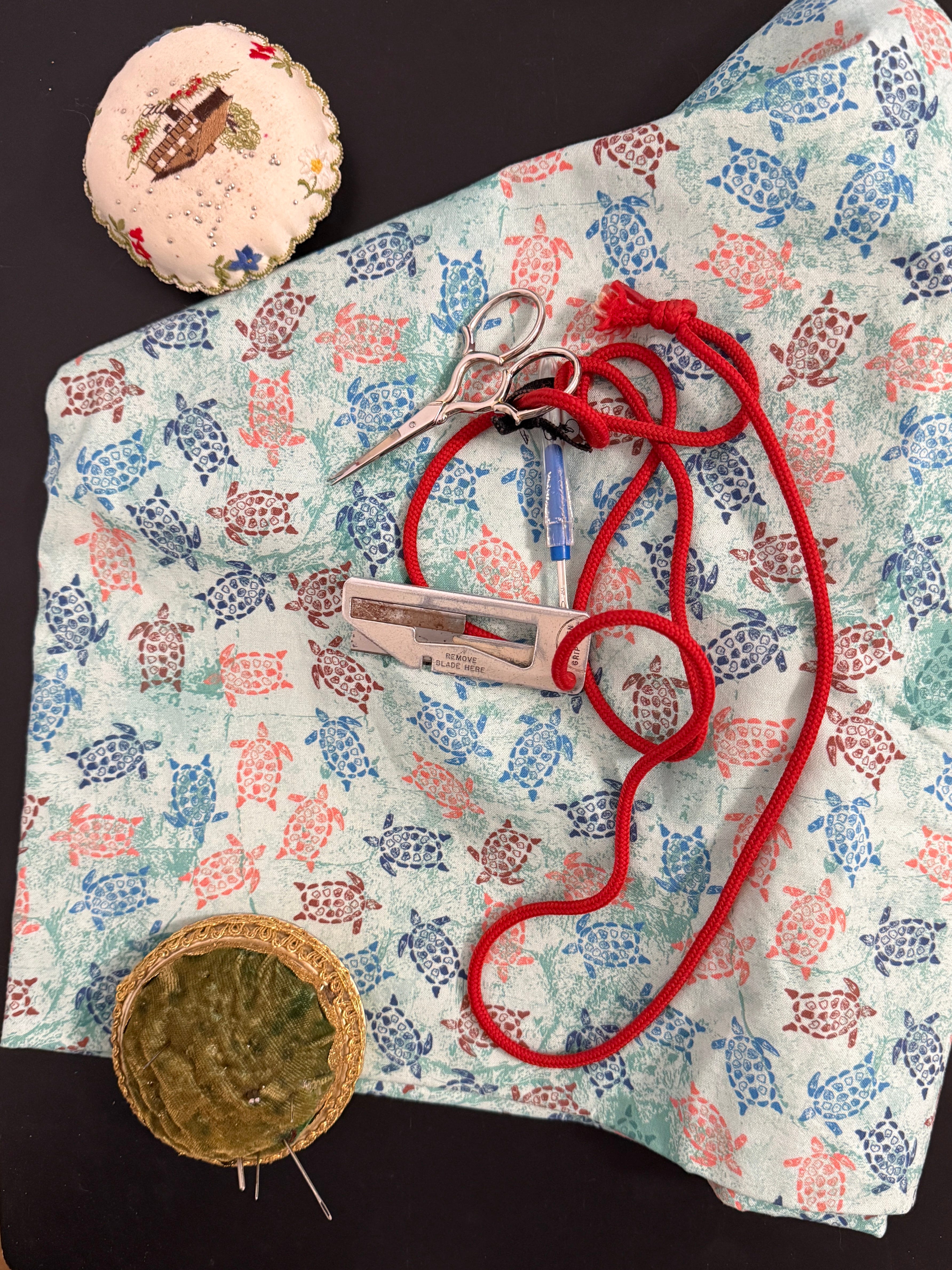
I want to name this parallel explicitly. Following symbolic rules without sensory grounding is what LLMs do, and Read is saying this is also what academic art training risks producing. This is another moment where I’m grateful that my training was in craft, in the actual experience of making something. Learning what it feels like to detect the subtle changes in the strength of a fiber as I press a razor blade against it, knowing that this fiber is the sewing thread and not the woven thread that the garment I am dexterously cutting apart is made from. I have this sensory experience, and only now am I thinking about the symbolic nature of the work I am producing using my human body.
This also makes me think about Michael Pollan’s A World Appears, which has been a companion to this reading. Pollan’s argument is that consciousness requires sensory assembly, not just symbolic processing. A tree is potentially conscious. An LLM is not, and may not be, with the current tools at our disposal.
What I am really thinking through as I read is how to help my students stay grounded in the sensory nature of their experience, and then, as future educators, how to help them communicate that sensory nature to their own students. We are not making a felt envelope because the felt envelope means anything in the abstract. We’re making the felt envelope because the act of stitching along its edge teaches the student what it feels like to make those stitches. Then we talk about it while looking at each other’s stitches, touching them, discussing how they are shaped and what we can know from seeing each other’s work, and how that communicates to us our own task of making. The sensory experience comes first. The meaning comes after.
All in all, I end up being very grateful that I have had a craft education grounded in sensory experience rather than an art education grounded primarily in symbolic content. I’m grateful that I had that experience first, so that as I now make my way through works related to the symbolic content of art, I am reflecting on that meaning in relation to my own sensory experience. This act of slow reading, using an actual physical book which is in itself a sensory experience, is bringing up questions I will sit with through the remaining days of this Early Summer season.
Thank you for reading what emerges from my process.
Gwendolyn