
Cypress Wisdom
When Trees Become Teachers

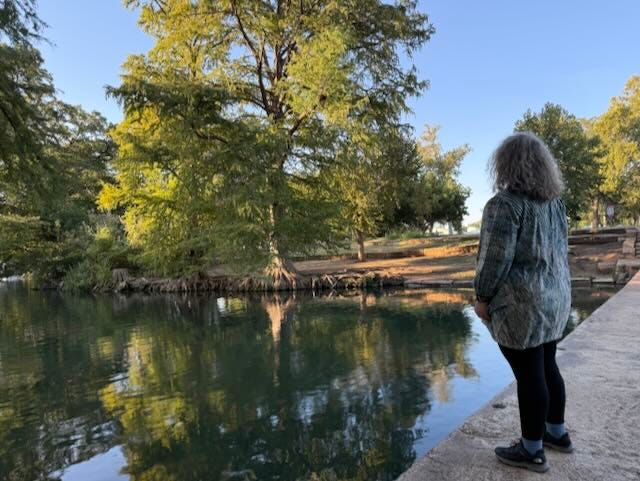
Standing on the banks of the San Marcos River, I am captivated by the huge bald cypress trees, their roots gripping the banks like enormous hands, with fingers disappearing beneath the water to reach towards the life-giving aquifer. Although I grew up in the Rocky Mountains, I definitely think of myself as a forest girl. I could take or leave the rocky part of the Rocky Mountains, but the faded green stands of ponderosa pines, dotted occasionally with a bright, light, green, or later in the year, orange, gold, of the aspen colonies, that really sparks my love for nature. So when I received a commission to paint a painting for the lobby of a building that will be named the Cypress Building, I was excited to return to painting the trees that I love so much.
I added “learning more about water ecosystems and water science” to my goals for this season. And that meant that, along with walking along the banks of the San Marcos River, looking at photos of cypress trees while walking in the walkers gallery at the San Marcos Activity Center and paying specific attention to the cypress trees of my landscape, I thought I’d probably better bone up on cypress trees.
I started by looking for a book that I could read. The search for books about cypress trees didn’t reveal a lot. There is one famous book, “The Great Cypress Swamps”, that I was able to find on Abe, my favorite online used bookseller, but I didn’t want to wait that long to get started.
So I broadened out my search and thought, “well, what’s the ecosystem that cypress trees are part of?” and “what’s available at my local public library?” This led me to a book called "Swamplands" by Edward Struzik that I was able to check out as an ebook on the Libby app. The swamplands that are the focus of this book start with the tundra bogs of Canada and Siberia and move through other swamp regions before arriving at the southern swamps in the United States.
And here, the cypress tree serves a really important role.
Ancient lineage and longevity: First of all, Cypress trees are among the oldest living groups of trees on Earth, according to my Internet searches. Their ancestors grew across Europe, Asia and North America 20 million years ago, and some of the specimens here in Texas are between 800 and 1,200 years old.
Physical adaptations: The bald cypress trees that grow around here have those distinctive, kind of knees that help to support the trees in soggy, porous earth and also aerate the submerged roots. This is the reason that cypress trees contain a compound called cypressene that helps to prevent rot in the wood, which is why cypress wood is especially valued for things like weatherproof areas, decks and roof shingles, and that sort of thing. Here in central Texas, where I live, the bald cypress tree is wonderfully adapted to go through long periods of dry weather, which is really important. We’re currently in a drought, and being able to hold water internally in the tree until the conditions improve is the reason they have lasted for millennia.
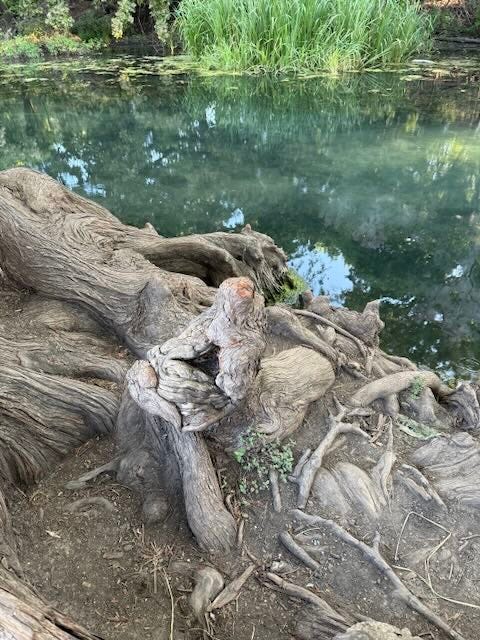
Ecological role: The roots of the cypress tree serve to stabilize the banks, and prevent erosion. They also provide a crucial habitat for wildlife and, like, fish or the amphibians, like the blind salamander [insert link here: Texas blind salamander or Edwards Aquifer endangered species], and for lots of birds. The cypress tree doesn’t grow alone, of course. There’s also trees like pecan, hackberry and sycamores. But the cypress trees are very iconic, in their striking size and unique shaped roots. Having such long and complicated roots, they help to slow floodwaters, which is another reason why we find them so important here.
Connection to aquifer systems: This stabilization is helpful because our rivers are cutting into or coming out of limestone aquifers, and limestone is actually pretty fragile and porous. That’s why it can form such amazing sinkholes, swimming holes, and runnels in the soft limestone. So, the cypress trees are essentially a connector between the aquifer landscape that I’m so interested in, and the river landscape that forms such an important part of our life here. They essentially live on the boundary between the land and the water and stand as doorways to the liminal zone between the river and the aquifer.
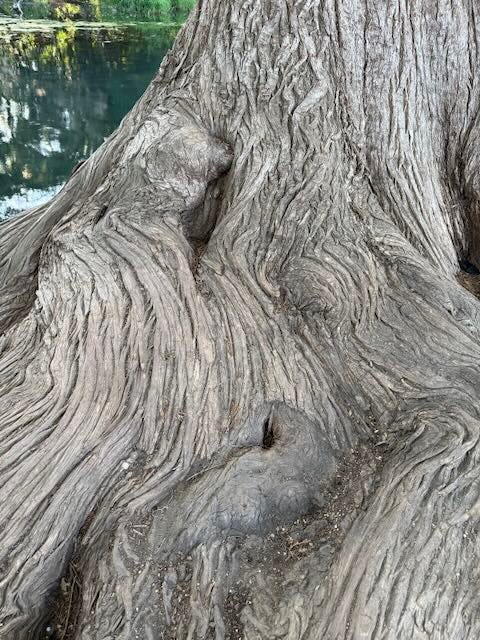
The reason that I decided to name the piece I’m working on “Cypress Wisdom” is because it serves as a guiding nature spirit.
As I think about the guidance of the cypress, I imagine how I want to keep my roots deep in the aquifer, providing stabilization. And at the same time, I want to be able to grow, ever upward, ever larger, providing habitats for thousands of ideas that may gather around my roots or set up nests in my branches. And the cypressene oil that prevents decay speaks to the ability to be resistant, to not allow the forces of nature, of weather, and flood, and erosion to change my position. Living like the cypress is to be essentially myself, tall and beautiful and proud, no matter what’s going on in the world around me.
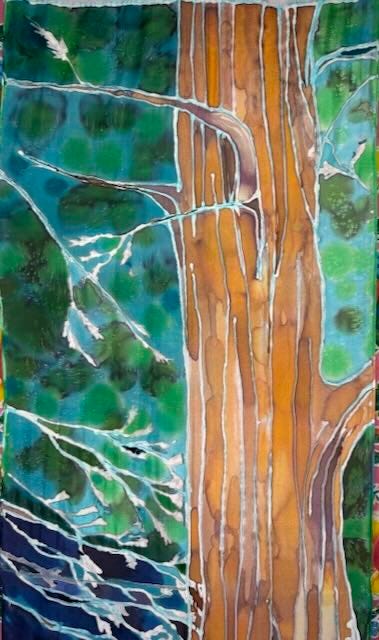
This important tree in our ecosystem provides a model for me in how to incorporate the wisdom of nature into my own life. Bending my knees, lifting my mighty weight, and sinking my roots into the aquifer, all of these are the lessons of the cypress wisdom.
As I work on painting Cypress Wisdom, I’ll be capturing more than a tree, I’ll be painting a portrait of resilience, of roots that refuse to lose their hold on what matters, of growth that happens both above and below the surface. These are the lessons we all need, as artists and human beings, navigating fragile ecosystems in uncertain times.
Thank you for reading what emerges from my process.
Gwendolyn